
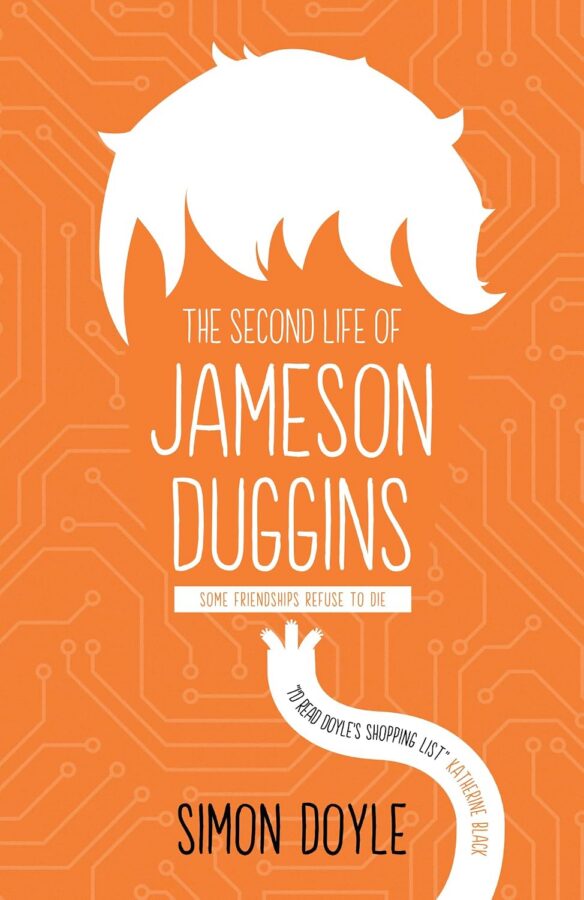
QSFer Simon Doyle has a new queer near-future sci-fi book out (gay): The Second Life of Jameson Duggins.
Jamie Duggins is dead.
Theo Fletcher knows that. He was there when Jamie fell from the clifftop, seconds before Theo could confess his love.
But that doesn’t stop him from doing something he knows he shouldn’t, in the depths of his late father’s basement lab.
Piece by piece, he brings Jamie back to life, with the help of their experimental neural interface and a 3D printer.
He might have synthetic skin, but he looks like Jamie and thinks like Jamie.
So why isn’t that enough?
As Theo falls deeper in love with the boy he rebuilt, a high-ranking military officer arrives with questions about his father’s secret research, and a dangerous interest in Theo’s creation. Worse still, Theo’s mother might know more than she’s letting on.
But Theo lost Jamie once… This time, he’ll do anything to keep him.
Warnings: Death, loss, unrequited feelings, family secrets
Get It At Amazon | Publisher | B&N | Bookshop.org | Kobo | Apple | Smashwords
Excerpt
“I’m slipping,” Jamie said, his teeth gritted against the pain of our fall.
“Just hold on,” I begged.
“I can’t.” His hand gripped mine, hot and wet with sweat. And then he said, “It’s not your fault, okay?”
I didn’t answer.
“Theo,” he said. The strain made his voice come out in a strangled breath.
I shook my head. “Don’t let go.”
That was the last word Jamie said: my name. Theo. He was the only one who ever called me that.
He clenched his eyes against the sweat that curled around his eyelids. Below him, his feet dangling, the waves crashed against the rocks. Dirt clung to his forehead and cheeks, and the jagged graze under his eye looked raw. Then he bit down on his lower lip. He didn’t let go; his fingers just slipped out of mine. And he was gone.
Off the side of Slieve League cliffs to the boulders below.
There was silence. And I was all alone.
I didn’t scream. I kept my hand outstretched, like maybe he’d reappear, maybe he’d suddenly grip my fingers again. And the pain in my chest had nothing to do with our fall. My vision clouded, as if I was bathed in a thick fog, and when I opened my mouth, no sound came out.
Not even his name.
I lay there, unable to move, my right leg bent at an unnatural angle, dislocated shoulder that was more numb than painful, and the only thing I could do was breathe. And watch the sunset.
I’d wanted to watch it with Jamie, not on my own. I’d planned this whole thing. We’d hike to the top, plant a flag, our club flag (it was rolled up in my pack, but I didn’t know where that was any more—probably down the side of the cliffs where Jamie went), and then we’d have lunch. I made sandwiches with extra Dijon mustard because that was Jamie’s favourite. I even had a red tartan picnic blanket in my pack that I found in a charity shop the week before. I’d pour sweet cider into plastic glasses and we’d get tipsy, and I’d confess my love to him. I’d say, “I like you,” and he’d say, “Oh my God,” even though he knew I didn’t believe in God, “I like you too,” and then we’d kiss.
That was the part I was looking forward to. The kissing.
Except we never made it to the top and I never got to confess my love.
My neck hurt. My back hurt. And the sun hurt my eyes as it bled into the dark Atlantic Ocean, dyeing the water orange and gold.
I didn’t feel the wind. I think I was sheltered from the worst of it on the rocky shelf I’d landed on, recessed from the cliff-face by little more than a foot. When I tried to take a deep breath, I couldn’t. I’m not sure if the thing that rattled was inside my chest or tucked among the mossy rocks on my right. And in that moment, I didn’t care. The sun broke the ocean into a million rubies.
I watched the clouds forming patterns on the horizon, which is called pareidolia, seeing recognisable shapes in random objects. Except I didn’t see rabbits and cute faces. I saw a trebuchet throwing fire over parapets. I saw a dagger piercing a human heart.
I saw Jamie with his back to me.
I blinked at the sun and when I closed my eyes, I could still see the burning shape of it.
And the redder the ocean got as the sun dripped molten lava into its inky darkness, the colder my body became. Half of my limbs were shivering, the other half too numb to move.
But by the time the sun had been doused out by the water, I wasn’t shivering anymore.
I imagined I heard Jamie’s voice calling my name. And I imagined the sound of a helicopter. And when the beam of a torch swept across my face and back again, I imagined my father saying, “There he is.”
At that point, I knew I was making things up, because my father, Dr Jonathon Fletcher, was dead. I’d watched him die seventeen months ago.
“Look, Jamie,” I tried to say, but my voice hurt my throat. I was going to point at my dad on the clifftop above me and laugh at how absurd it was that he should be there, but I couldn’t lift my hand.
And I couldn’t laugh.
More flashlights appeared, beams of white light like alien spacecraft, hovering in the air as they decided whether to abduct me or not, and my dad’s voice was no longer his. It belonged to a stranger, deep and full of gravel.
Or maybe that was just my ears.
The sun had finished swimming in the ocean by the time two men had descended the cliff-face and crouched over me to check my pulse. The sky in the east was turning grey. The men inspected my limbs that I think had probably grown roots into the ground beneath me, and they covered me with a foil blanket and said some words that I expect were meant to be comforting. But I said, “Jamie.”
“He’s trying to speak,” one of the men said.
“Get Jamie,” I told him, my finger stretching to the cliff’s edge.
“You’re all right, son,” he said, and the laughter in my chest still didn’t erupt. He was not my father and I was not his son. “You’re safe now.”
“Jamie,” I tried again. He held something over my nose and mouth, and the air smelled metallic. “I didn’t tell him,” I said. “I didn’t tell him I love him.”
Author Bio
Simon Doyle (he/him) was born and raised in Ireland. He won a local poetry competition at the age of nine, which sparked a lifetime love of words. But he swears never to write poetry again.
He is the author of “Snow Boys” and “This is Not a Vampire Story”.
He lives with a very neurotic rescue dog, and Lucas, his human soulmate. They met in kindergarten. Where all good stories begin.
| Author Website | https://simondoylebooks.com |
|---|---|
| Author Instagram | https://www.instagram.com/simondoylebooks/ |