

Genre: Solarpunk, Afrofuturism, Sci-Fi
LGBTQ+ Category: Intersex (side character)
Reviewer: Beáta
Kobo | Bookshop.org | Smashwords | Apple Books | B&N
About The Book
An autistic grandma struggles to fit in because her village has a very tight sense of community. To avoid being seen as anti-social, since its easier for her to interact with others over work, she accepts to chair the committee for national defense.
The job is simple, requiring her to coordinate responses to the climate crisis, until a colonizing superpower invades to capture the technology that makes her country a solarpunk utopia.
Her nation is a loose union of hundreds of thousands of self-sufficient villages, and they have no army, no weapons, so how will she coordinate their defense? Will the invasion lead to a disintegration of their utopia, or will they find a way to defeat the colonizer?
The Review
In an utopian future, what is today Uganda and some neighbouring countries has dissolved into a federation of autonomous villages that function as an absolute democracy. New technological inventions mean that people can live in comfort and have all their needs met. This utopia is threatened, when their neighbour country Kenya forms an alliance with the United States and attacks them to lay their hands on their technologies. The federation is a peaceful place without any weapons of mass destruction, and an army specialized in providing aid rather than fighting. The closest they have to a Minister of Defence is Adita, an elderly peasant woman who struggles with interpersonal relationships, and whose job as chairperson of the committee usually revolves around coordinating disaster relief. To save her world, she must use all her wits—, and quickly, too. All this, while enemy spies watch her every move…
This was a very interesting novella. Science fiction that presents a new world always is.
Dilman Dila created a future that is very utopian, and his story asks the big question that utopias are faced with: what happens, when something goes wrong? In this case: How can a society remain peaceful and maintain open communication when faced with war and espionage? But other questions arise: the pros and cons of a justice system based entirely on popular vote and excommunication, or the role of disabled people who might struggle with keeping up the social connections that are required to function well in their society.
Beyond the social questions, the technological infrastructure is also interesting, and worth closer examination. It is a solarpunk future, and solarpunk offers some much-needed discussions about a sustainable future. Unfortunately, I am not a good person to do it.
All in all: If Dilman Dila’s goal was to create an interesting and engaging world, then he definitely succeeded.
The characters show the different ways to be human in a utopia. From a grumpy grandmother who would prefer to be left alone, over an aging scientist who is struggling with accepting that the new generation wants to use em’s inventions slightly differently than originally intended, to a school teacher who is running a space program in her free time, you get glimpses into what lives could be like, if the world was a slightly better place.
Given the audience of Queer SciFi, I probably should mention somewhere that this book does have a nonbinary character: Lokang, the inventor whose work has made the entire utopia possible, is described as having both male and female characteristics, and uses a gender-neutral pronoun. Based on em’s description, em is probably intersex.
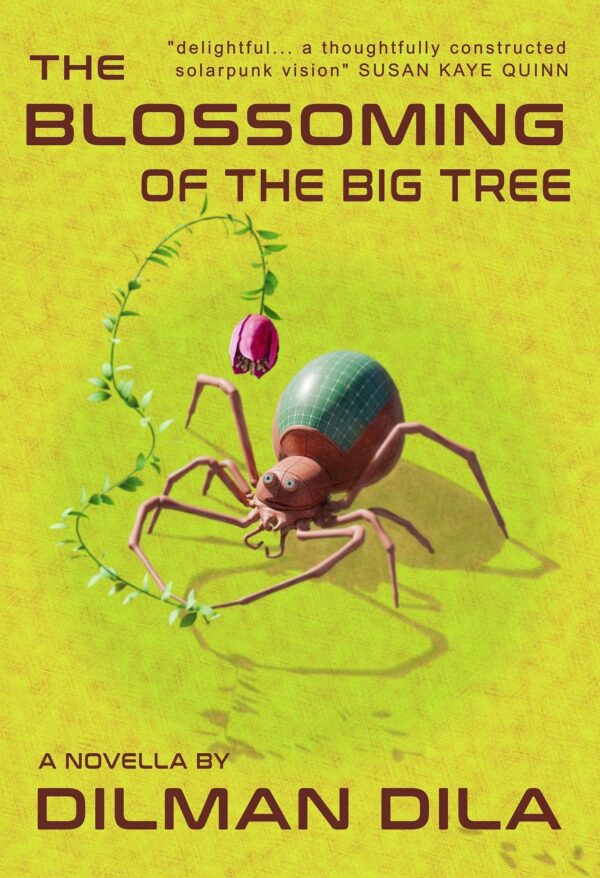
The Blossoming of the Big Tree is the first novella in hopefully a series of science fiction novellas from the still young Ododo Press. They are based in Uganda, and their goal is to focus mainly on Africanfuturism, Afrofuturism, Science Fiction, Fantasy, Horror, Solarpunk, and Hopepunk. If The Blossoming of the Big Tree is the quality that they’ll keep up in their future books, then it might be worth keeping an eye on them: We might get some really good science fiction out of it.
The Reviewer
Beáta Fülöp is an aspiring filmmaker and writer. She identifies as aromantic and asexual, and has an autistic Special Interest in the representation of minorities. One day, she will use this knowledge in her own stories. Until then, she is happy to sit here and give her opinion on other people’s hard work.