

Genre: Sci-Fi, Steampunk
LGBTQ+ Category: Bi, Lesbian, Non-Binary, Poly
Reviewer: Beáta
Get It On Amazon
About The Book
In the conclusion of the trilogy, the Martian people must secure their rights once and for all—at the risk of destroying everything they have built over centuries.
Lucy runs from her feelings to Earth, where she tries to gather new allies for the Martian people. Shattered but stubborn, Moira navigates the criminal underworld of Halfpoint Station. But to unearth a plot that threatens the nascent revolution, they will have to swallow their pride and reach out to one another.
Separated from their beloved by the tides of war, Sagan takes up a rifle and marches with the People’s Army. This is their chance to win their rights at last—or is it a betrayal of the man they love?
The Review
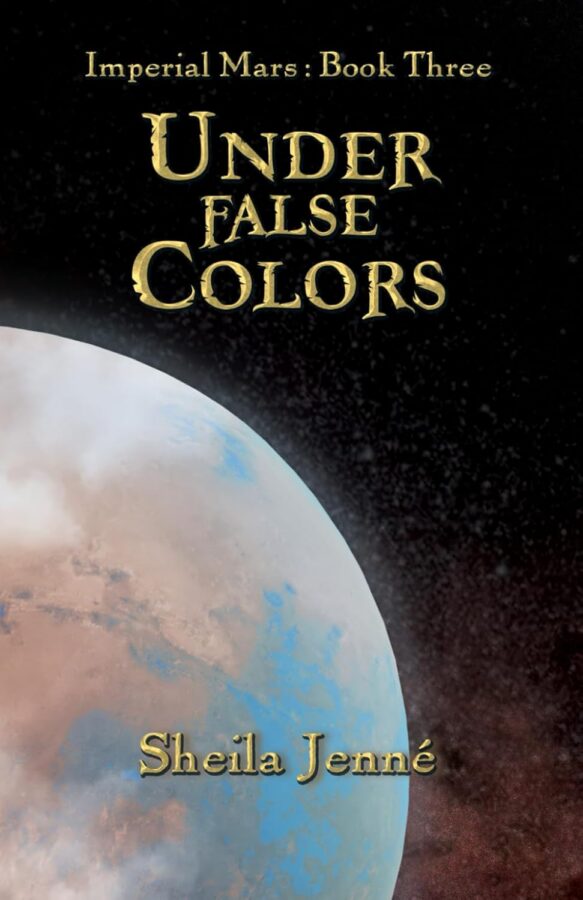
Under False Colors is the third book in the Imperial Mars trilogy. The second book ended with a revolution breaking out on Mars, and that’s where this one picks up. As the revolution turns more and more violent, evidence shows up that the key figures pushing it into more extremes are secret agents from the enemy Earth, sent to sabotage Mars – and they actually stop the terraforming process that makes the planet inhabitable. It’s a race against the clock to gain back control over the revolution, before the planet’s atmosphere is blown away by solar winds.
I am a big fan of Sheila Jenné’s work. I genuinely consider her one of my favorite contemporary science fiction authors, and one of my favorite contemporary authors in general. The Imperial Mars books are a special favorite of mine, as it is a very good story that has some interesting things to say about society.
I also love Lucy and Moira’s relationship. (It is very interesting, and they are both very stupid about it.) As such, I had been looking very much forward to the third book, and my expectations were quite high.
I was not disappointed.
Under False Colors is a good third part – and end – of the series. It picks up characters and ideas introduced in the first two books, and elaborates further on them. It also lets the characters interact, and I really loved the collaboration that happened on multiple levels. From scientists coming from different planets working together to build a computer, over Moira’s crew passing along important information to each other, the entire book relies on people working together.
An interesting dimension is added by the promotion of Sagan to a point of view character, as they are versed in the entire behind the scenes and spy business in a way that Lucy and Moira simply aren’t. They are also a very, very fun character to watch, since they are hypercompetent, and improvise their way through a very destructive revolution.
Lucy and Moira continue to struggle with basic communication, as they are both traumatized by the class divide they were raised in. As with the worldbuilding, I keep appreciating how nuanced they both are, and so is their relationship.
My only critique is that I would have liked to see more of Earth’s society. Books one and two did a great job presenting us the very different social structures of Mars and Venus, and gave us time to sit with them and really let their ways of functioning sink in. I had hoped that the same would happen to Earth in book three. While Lucy does visit the planet, it takes up much less space than Mars and Venus had. To be fair, we are in the third act of the story now, and things are moving much quicker than they did in books one and two. The stakes are higher, too.
TL;DR: Great ending for a great science fiction trilogy that more people should know about.
The Reviewer
Beáta Fülöp is an aspiring filmmaker and writer. She identifies as aromantic and asexual, and has an autistic Special Interest in the representation of minorities. One day, she will use this knowledge in her own stories. Until then, she is happy to sit here and give her opinion on other people’s hard work.