


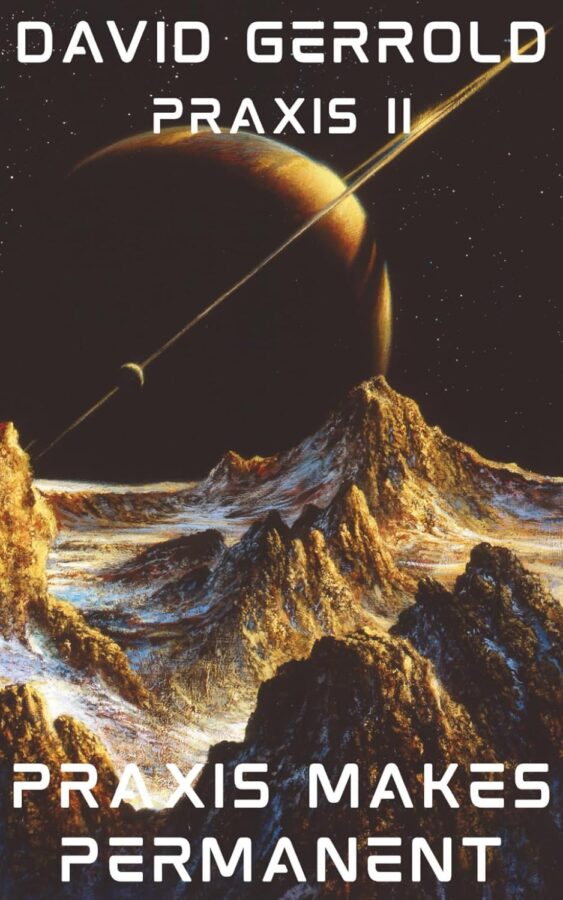
QSFer David Gerrold has a new queer sci-fi book out, Praxis book 2: Praxis Makes Perfect.
DAVID GERROLD—Hugo & Nebula Award winner—presents: Praxis Makes Permanent, the thrilling conclusion to the extraordinary journey of Jamie and José to the colony world Praxis!
Praxis Makes Permanent is the highly anticipated conclusion to Praxis! Jamie and José have hurtled headlong into a world where nothing is what it’s supposed to be. Praxis is in rebellion, but who are the players and what do they want to achieve? If everything is chaotic, where do Jamie and José fit in? And guess what? They’re the biggest part of the problem!
Get It At Amazon | B&N
Excerpt
One
The train was impressive on the outside—a chain of huge pill-shaped cars, each one as wide as five ordinary train cars. They had to be wide to hold all the supplies and the massive equipment the colony would need—and the cars needed to be large because there was a limit on how long a train could be, so each car needed to be its own self-sufficient environment, as the whole train was going to pass through multiple hostile environments, low-gravity, high-gravity, low-pressure, high pressure, possible storms, probable vacuum, and a few below-ground tunnels so the contents—us—wouldn’t get roasted by heat or radiation.
It was impressive on the inside too. The cars had an airlock at each end, and connecting airlocks between them. Depending on the cargo, each car could have five distinct floors, although some did not, just a large open space for bulky cargo and heavy equipment.
When a car did have floors, the bottom level was all the machinery and supplies for maintaining a livable environment, air and water especially. The next floor up was storage and cargo. Above that were cabins, lounge, galley and service areas and additional survival equipment. If necessary, every level could be pressurized and sealed. But it wasn’t cramped. It felt like a luxury cruise ship. I’d only seen pictures, so maybe I was imagining, but I could see why the trains had to be comfortable. We’d be living here for quite a while. Some trains had taken two months to reach their destinations. Even farther out, possibly longer.
José and I found our cabin easily. We closed the door behind us, looked at each other, and after a long uncertain moment, we hugged. And after a longer moment, we even started laughing. “We’ve come a long way.”
“And we still have a long way to go.”
I pulled down the bed so we could sit side by side. I put my arm around his shoulders and pulled him close. I looked at us in the mirror opposite, met his gaze and said, “Thank you.”
“For . . . ?”
“For everything.”
“Uh-huh, yes,” he agreed. “Everything.”
Well, not everything. We still had a lot to talk about, but we’d have time.
Our journey to Praxis was expected to take two weeks, maybe three, or maybe even as long as a month, depending on the amount of traffic up and down the line.
Most people don’t understand how the portals work, even the intelligence engines aren’t certain. They just juggle the probabilities and most of the time they get it right. Most of the time.
A portal is a hole in space. It opens to another . . . place. There are two ways to make a portal. One is to open a zero-based portal, go through it, grab the other side and schlep it off to someplace useful. So if you were to open a portal in New York, grab the other side of it and drag it off to London, you would have a big circular doorway direct from Times Square to Piccadilly Circus, which is great for shopping, exchange rates, and the rapid spread of viral mutations.
Or you could grab that other side, and launch it off to Luna or Mars. The result is a known portal that lets a person travel off-planet for the cost of a ticket—but tourism to Luna or Mars isn’t cheap, what drains your wallet is the cost of survival once you get there.
But it’s still cheaper than the whole space travel adventure, which I am told can get pretty boring for passengers after the second or third day. It’s not like a cruise ship. It’s cramped, high-gee acceleration is uncomfortable, the internal machinery of the ship is loud, and if the idea of using everyone’s recycled water for drinking (or what passes for bathing in free fall) gives you the squicks, then travel by portal is a much easier alternative. In short, space travel still belongs to engineers and billionaires who like to be dramatic.
The important thing about portals is that they provide cost-effective access. You can load up a cargo pod with all your supplies, all your survival necessities, and all your heavy machinery, and go. You find a nice stable place, you can build the strongest containment possible, a really strong containment where you don’t have to worry about maybe blowing a Montana-sized crater in the landscape and once you’re off Earth, you can safely generate multiple portals and launch them all over the solar system. When those distant doorways are all in place and functioning, you have portals direct to Ganymede, Titan, Europa, Ceres, parts of Mercury, Sedna, and anywhere else anyone is willing to pay for.
Putting portals all over the solar system is a great time-saver for scientists, astronomers, and industrialists who want to dig mines for stuff without having to worry about environmental protections. Once the first few billions are recovered, portals can be cost-effective. There’s a lot of tourist travel too, but most off-planet resorts are still sealed environments.
Sending a portal to another star system is a whole other problem, because you have to send the other side of the hole to the desired destination before you can step through.
It requires a starship.
Author Bio
David Gerrold’s work is known around the world. His novels and stories have been translated into more than a dozen languages. His TV scripts are estimated to have been seen by more than a billion viewers.
Gerrold’s prolific output includes stage shows, teleplays, film scripts, educational films, computer software, comic books, more than 50 novels and anthologies, and hundreds of articles, columns, and short stories.
He has worked on a dozen different TV series, including Star Trek, Land of the Lost, Twilight Zone, Star Trek: The Next Generation, Babylon 5, and Sliders. He is the author of Star Trek’s most popular episode “The Trouble With Tribbles.”
Many of his novels are classics of the science fiction genre, including The Man Who Folded Himself, the ultimate time travel story, and When HARLIE Was One, considered one of the most thoughtful tales of artificial intelligence ever written. His stunning novels on ecological invasion, A Matter For Men, A Day For Damnation, A Rage For Revenge, and A Season For Slaughter, have all been best sellers with a devoted fan following. His young adult series, The Dingilliad, traces the healing journey of a troubled family from Earth to a far-flung colony on another world. His Star Wolf series of novels about the psychological nature of interstellar war are in development as a television series.
A ten-time Hugo and Nebula award nominee, David Gerrold is also a recipient of the Skylark Award for Excellence in Imaginative Fiction, the Bram Stoker Award for Superior Achievement in Horror, and the Forrest J. Ackerman lifetime achievement award.
In 1995, Gerrold shared the adventure of how he adopted his son in The Martian Child, a semi-autobiographical tale of a science fiction writer who adopts a little boy, only to discover he might be a Martian. The Martian Child won the science fiction triple crown: the Hugo, the Nebula, and the Locus. It was the basis for the 2007 film Martian Child starring John Cusack and Amanda Peet.
Gerrold’s greatest writing strengths are generally acknowledged to be his readable prose, his easy wit, his facility with action, the accuracy of his science, and the passions of his characters. An accomplished lecturer and world traveler, he has made appearances all over the United States, England, Europe, Canada, Australia, and New Zealand. His easy-going manner and disarming humor have made him a perennial favorite with audiences.
David Gerrold is the 2022 winner of the Robert A. Heinlein Award.
| Author Facebook | https://www.facebook.com/davidgerroldauthor/ |
|---|