


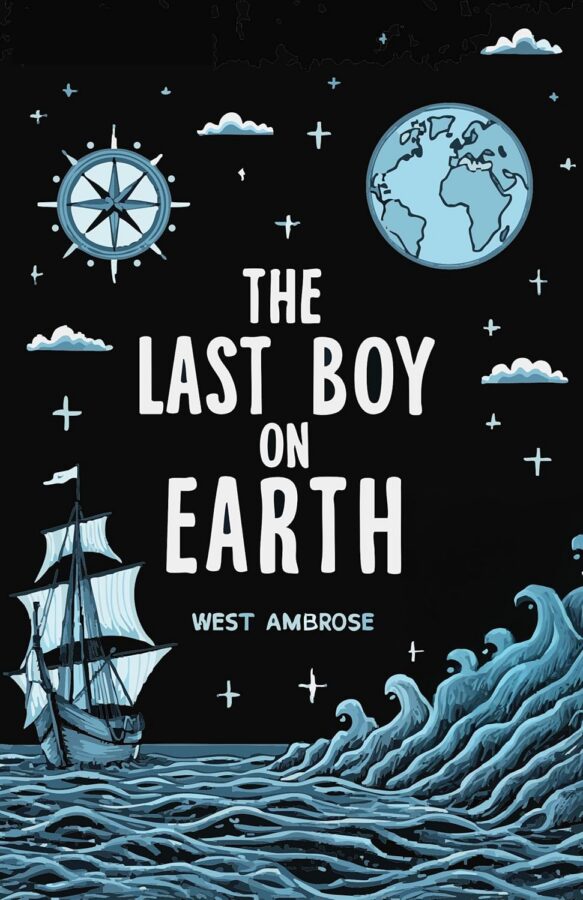
Genre: Queer Speculative Fiction, Post-Anthropocene, Sci-Fi/Fantasy, Slipstream
LGBTQ+ Category: Gay, Gender Fluid
Reviewer: Ulysses
Get It On Amazon
About The Book
Two boys, alike and undying, from borderless Illyrial, where we [de]lay our post- anthropocene: Julian and Vern are equally lost and differently, tenderly, iridescent pearls; one in the deep sea and the other by the sandy shores, encroaching. Julian, an unlikely passenger aboard an undersea ship with no destination and captained by a madman, seeks to unfold the past by throwing himself into new liaisons with beautiful men and creatures. Still learning how to swim, Vern kicks frantically against the undertow of his misfortunes as he alchemizes his desires. Despite taking separate voyages, their meeting soon becomes inevitable. Past The Shallows and into The Below, what begins as a tenuous meeting of opposites quickly becomes a lovers’ pact.
Aboard the Clarel, all is not as it seems. Adrian captains the ship, oblivious to all except the needs of his crew, accompanied by an ache he has known for as long as he can remember. Dimitri, his steadfast navigator, draws detailed maps to every place they could ever voyage…all except one.
As the four newfound crewmates navigate murky waters and each other, they quickly enter in a race against time to help both Julian and Vern return to where they were born. For both boys, the lyrical journey is as metaphorical as it is lived. Deep oceans filled with long-lost memories call to them, carried by the tide in a siren cry of a kingdom they might once have called home.
But where is home? And how are they to get there without a map?
West Ambrose is a scrivener and performing artist.
The Review
It took me a bit, but I got hooked by this fantasy epic story of twin brothers, Vern and Julian, trying to find their way home. But: it’s not that straightforward. The world that West Ambrose helps us inhabit is mostly underwater. I think we spend some time in The Above, which I’d guess is on land. This is where we meet Vern, who is a coddled and acclaimed celebrity, the self-proclaimed Last Boy on Earth. Although we learn that he prefers men, he avoids all discussion of his gender and sexuality. His cultural approach to romance and intimacy are very different from what he has found in The Above. He is from somewhere else, and he wants to go back.
There is also a big issue of memory and forgetting in Vern’s life. He says he is immortal – or at least, undying. I think that forgetting is how he deals with the hard parts of his endless life (his age is just as hidden). He seems to have forgotten (at first) that he has a brother, and somehow gets himself tied to an unsavory exploiter named Duke Eric. The particular trick is (I think) that when he (or anyone in the book) remembers something important, we find the narrative shifted flashback-style to that place and time. Eventually it becomes helpful, but at first I was confused a lot.
The author is also a poet (and a scrivener, which is a great word we should use more often, calling to mind Herman Mellville’s Bartleby the Scrivener). This explains the prose style and the whimsical, sometimes camp use of language.
Early on, Vern meets his twin brother, who is pretending to be a journalist. Julien (nickname Joules, which brings to mind Jules Verne and 20,000 Leagues Beneath the Sea, which could be a coincidence). Eventually they both end up on the undersea ship, the Clarel (which is also the name of a Melville poem about a crisis of faith). The ship’s captain, Adrian, and his first mate (or whatever) Dmitri, have a complicated relationship, both with the twins and with each other. Together, they set off in the Clarel, to find answers to the questions they all have about who they are and where they’ve been. What we come to understand is that all of these men, are in fact not really human, but sea creatures, sea people. This is important not just because they come from different parts of the Below, but because they have differing physiognomies and respond differently to places closer to the surface (Above), such as The Shallows, where air and water are not the same as below.
Along the way, we learn a good deal about everybody on board, the whole fairytale crew of highly gifted, skilled, and possibly magical people, who form a kind of found undersea family that look at Vern and Julian as both treasured guests and as possibly sort of sacred beings. Maybe. It’s quite an unforgettable adventure.
I confess I couldn’t keep out of my head the theme song from “Spongebob Squarepants.” It helped me understand the idea of an underwater ship which is filled with water. I still have questions.
Four stars.
The Reviewer
Ulysses Grant Dietz grew up in Syracuse, New York, where his Leave It to Beaver life was enlivened by his fascination with vampires, from Bela Lugosi to Barnabas Collins. He studied French at Yale, and was trained to be a museum curator at the University of Delaware. A curator since 1980, Ulysses has never stopped writing fiction for the sheer pleasure of it. He created the character of Desmond Beckwith in 1988 as his personal response to Anne Rice’s landmark novels. Alyson Books released his first novel, Desmond, in 1998. Vampire in Suburbia, the sequel to Desmond, is his second novel.
Ulysses lives in suburban New Jersey with his husband of over 41 years and their two almost-grown children.
By the way, the name Ulysses was not his parents’ idea of a joke: he is a great-great grandson of Ulysses S. Grant, and his mother was the President’s last living great-grandchild. Every year on April 27 he gives a speech at Grant’s Tomb in New York City.